
Il Gigante
On turning twenty-five years, two books, and a new kind of tool into something that breathes — the way a block of marble becomes David. Why T2D3 OS was quarried from daily practice rather than specified, why the AI is the chisel and never the sculptor, and how a community of beta users shapes the square while one head still holds the whole figure.
Stijn Hendrikse · Aug 27, 2026
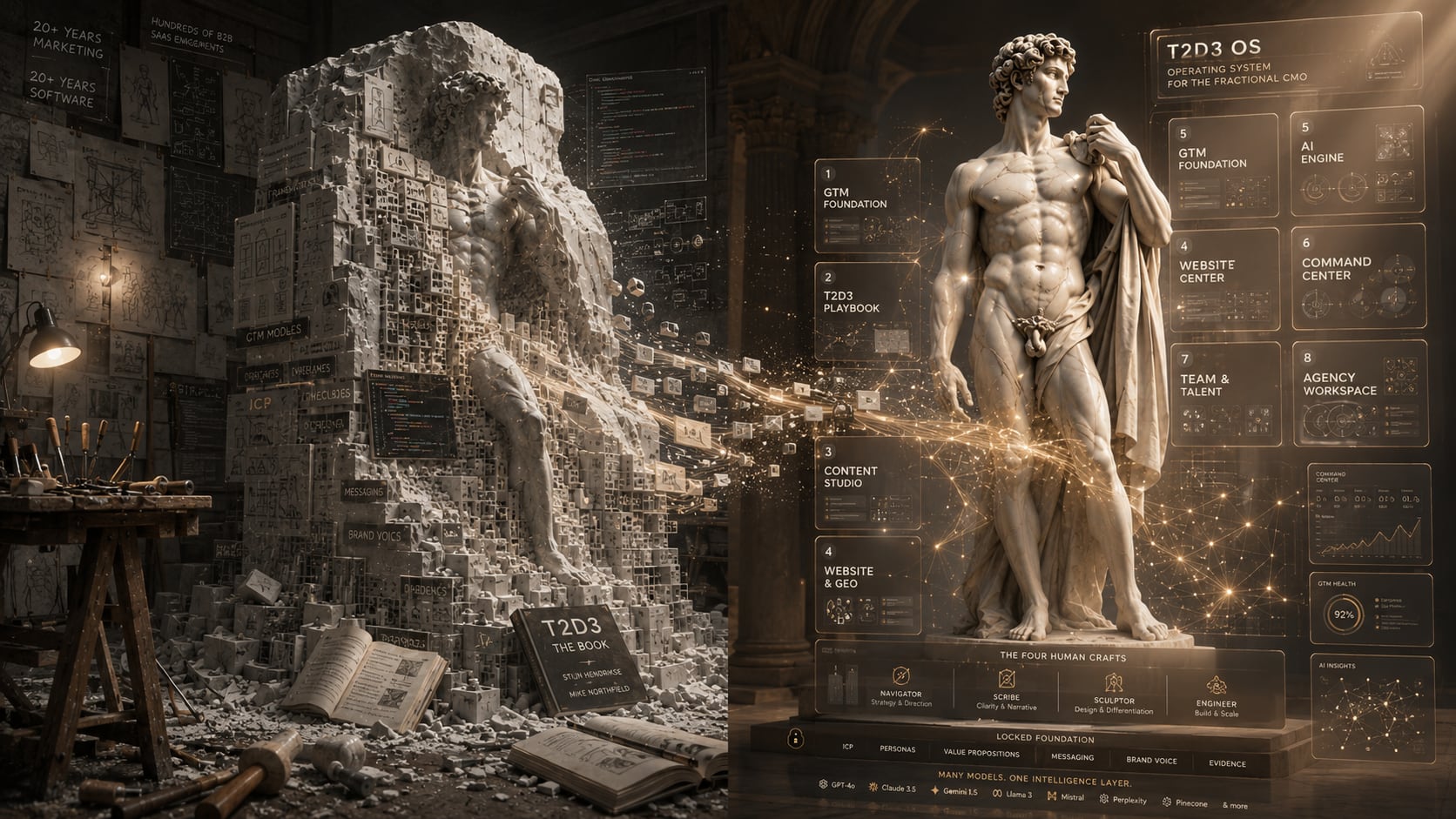
On turning twenty-five years, two books, and a new kind of tool into something that breathes — the way a block of marble becomes David.
For forty years the block waited.
It had been quarried in Carrara, roughed out, and abandoned — a slab the master sculptors of Florence had circled, tapped, and walked away from. Too tall, too narrow, too flawed. They called it Il Gigante, the Giant, and left it lying in the cathedral yard, open to the rain: a ruin of white stone that everyone agreed was ruined.
Then a young man of twenty-six walked up to it and saw David already inside.
That is the part people forget about Michelangelo. He did not invent David. He insisted the statue was already complete within the stone — that his only task was to chisel away everything that was not David and let him step out. Creation, for him, was subtraction. The genius was never in what he added. It was in what he had the nerve to remove.
He did not invent David. The statue was already complete within the stone — his only task was to chisel away everything that was not David.
— Michelangelo · 1501
We have our own block.
Mine was quarried over twenty-five years of doing the work — as a CMO, as a fractional CMO, as a coach of marketing teams and their leaders. Hundreds of B2B software companies; boards calm and boards on fire; engagements large, political, and small. The books were the cartoon sketched on the marble — T2D3 first, Syntropy after: here the shoulder of a real go-to-market motion, here the turn of the head, here the tension in the hand before the sling flies. Others looked at B2B marketing and saw a ruined slab — dashboards, noise, vanity metrics, a giant nobody could lift. I looked at the same block and saw David.
But a drawing on marble is not a statue. Freeing him meant a million precise cuts, and no single pair of hands makes a million cuts in a lifetime. The potential was real. It was also imprisoned.
Then the chisel arrived that could. The AI is not the sculptor — it is the chisel: tireless, capable of ten thousand strokes a day, and blind to David until a hand guides its edge. So I put my hands to the stone. For seven months now, every day of real work — winning a client, running their marketing, coaching the team, sitting with the executives, down to how I run a meeting and take its notes — has become that day's cuts. That is why T2D3 OS has grown so rich, so fast: it was never specified. It was quarried, stroke by stroke, from the daily practice of the role itself.
And richness, remember, is what a block is. Too tall. Too broad. Too much. A giant.
Michelangelo understood something about that stage of the work. He had boards raised around the Giant and carved behind them, mostly alone, for three years — not out of vanity, but because the figure existed whole in exactly one place: his head. No one else could be trusted to know, mid-stroke, whether a ridge of stone was surplus or shoulder.
Our workshop has its version of that. In the language of the new tool: I am the long context window. Twenty-five years of engagements loaded, so to speak, into a single session. A model hallucinates when it answers beyond its grounding — fluently, confidently, wrong. People do the same. A CMO two years into the craft, or one who has only ever seen it from one seat, will propose the figure with complete conviction — and describe the corner of the block they know. That is not a flaw in them. It is what grounding does: it ends where your experience ends.
And yet — when David was nearly done, Michelangelo did not decide alone how he would meet the world. Florence convened its artists, Leonardo and Botticelli among them, to argue in committee over where the Giant should stand. The sculptor kept the chisel. The city shaped the square.
That is the balance we are striking now with our community and our beta customers. Every one of them is taken absolutely seriously — how a working CMO actually moves through this product is ground truth I can get nowhere else. Where she stalls, there is stone in the way, and how she does her work is critical to what this must become. And at the same time: no single user can see the whole figure. The two-year CMO cannot yet feel what the fifteen-year veteran will reach for; the veteran no longer remembers how the giant looks on day one. Each, holding the chisel, would cut a David shaped like their own corner of the work. The old story goes that when a Florentine official complained the nose was too thick, Michelangelo climbed the scaffold, palmed a handful of marble dust, faked the strokes, and let the dust fall. We don't get that trick — our critics don't admire from the square below. They will live inside the statue.
So for now, the place where all of those views assemble into one figure is the same place Michelangelo kept his David: one head. Imperfectly — I would be the first to say it — but held together, all of it, at once.
The workshop and the figure — code and marble in one frame; the block still shedding what was never him, and David, luminous, stepping out.
Look at the workshop. Marble and code in the same frame; anatomical studies pinned beside the blueprints; the figure half-freed, still shedding blocks of stone that were never him. Every rule the system enforces is a cut that cannot be un-made — so the stone can never crack back into noise. It is the same act Michelangelo performed, only the medium is now signal, and the discipline is subtraction: chisel away everything that is not the true motion until only David stands.
And then he steps out. Complete, luminous — the dashboard beside him not bolted on but grown from him. The magic was never the machine. The magic is that David was always in there — in the years, in the books, in the daily craft — waiting for an edge sharp enough and a hand sure enough to set him free.
The magic was never the machine.
David was young. He beat the giant not with mass but with precision: one true stone, well aimed.
So is this.
T2D3 OS
After Michelangelo's David — marble, carved 1501–1504, Florence, from a block others had abandoned. Written alongside the machine that helped free ours.