
It invents the specifics
Customer counts, funding amounts, integration lists, award years — plausible numbers that were never true. The dangerous ones are the citations and case studies that read perfectly and don't exist.
Humans are the loop
Left alone, AI is a brilliant unsupervised learner — and a noise machine in your market. What it's missing is supervision: your judgment about who it's for, what's true, and what good looks like. T2D3 OS is built so every generation starts from human signal and every verdict you give trains the next one. You aren't just in the loop — you are the loop.
None of these are hypothetical. They are the standard failure modes of running a marketing function on general-purpose AI, and they cost more to correct than the AI saved.
Customer counts, funding amounts, integration lists, award years — plausible numbers that were never true. The dangerous ones are the citations and case studies that read perfectly and don't exist.
A renamed feature reverts to the old name mid-campaign. A prospect's company is spelled three ways across one sequence. A merged-title contact gets addressed as a job function.
The single most expensive failure: context bleeds, and a competitor's differentiator gets written up as yours. Once that's in a whitepaper, sales finds out from a prospect.
Your competitors prompt the same models with the same brief. Without a locked voice and a real point of view, three companies publish near-identical posts the same week — and none of them wins the category.
The positioning agreed in week one is gone by week six. Each new chat starts from a blank slate, so the strategy quietly reverts to the model's defaults and drifts back toward generic.
A launch email that ships before the launch. A nurture sequence delivered out of order. Time zones, quarter ends, and embargo dates are exactly the details a model has no stake in.
Old pricing on a live landing page. Last year's headcount in a bio. A retired tier still being sold, because nothing told the model the plan changed.
Twenty variants, no verdict. Volume is the one thing AI is free at, and it's the one thing nobody needed more of. Someone still has to say which one ships.
Poor-quality, redundant, and inaccurate data is estimated to cost the global economy $3.1 trillion a year — and organizations routinely spend more correcting AI-produced errors than the AI saved in the first place.
Signal is the part AI cannot originate: who it's for, what it's for, the dollarized pain, and your customers' actual words. In T2D3 OS that foundation is a first-class object — your ICP, personas, value propositions, positioning, and brand voice live in the platform, get quality-graded, and are injected into every generation that needs them.
So the model is never guessing at facts nobody gave it. Outputs show what they were grounded in, which means you can check the work instead of trusting it. And because the foundation is held once and reused everywhere, the positioning you agreed in week one is still the positioning in week six — no session amnesia, no quiet drift back to generic.
You are the loop
Human signal → AI draft → human judgment → new signal → better draft
Locking a module, editing a line, rating an asset — each act of judgment is captured and distilled into guidance that shapes the next generation. Machine learning has a name for this: supervision. The model brings patterns learned from everyone; your feedback is the training signal that makes the output yours. The work compounds instead of resetting.
The signal refinery
Signal moves through a refinery. Raw material is hauled in, graded and smelted down to what matters, forged into decisions, and sharpened into the work your customer pays for.
Ore— capture
Catch
What you know exists in your nets, but haven't put in your hold — the Gong login, the promised customer list.
Capture
In your library. The machine makes it readable on its own.
Smelt— grade
Clarify
The machine reads and grades every document — type, value, what it can feed.
Comb
You vote. Kept signal is what everything downstream builds on.
Forge— decide
Codify
Signal becomes a draft ICP, personas, value props, brand voice.
Convict
Locked. The team commits and executes against it.
Edge— ship & compound
Convert
Shipped work with performance attached — what converts, what draws.
Compose
Proven winners. Their pattern becomes the score the next work is written from.
Compound
The business outcome — revenue, profitability, better-fit customers.
Tailings — reviewed out
Tailings — what grading reviews out. Winners feed the next cycle.
ORE IN — what you upload
EDGE OUT — what the client pays for
Some things don't come from a model at any quality setting: taste, a hard strategic call, a designer's eye, an implementation nobody on your team has done before. T2D3 OS combines integrated talent networks with our own expert marketplace and the T2D3-certified community, so extra human capacity is part of the platform rather than a separate procurement exercise.
Navigator
Strategy, prioritization, and the decisions about what to kill.
Scribe
Narrative, voice, and the customer's truth in their own words.
Sculptor
Visual and emotional coherence — subtraction until only clarity is left.
Engineer
Systems that scale the work without losing the signal.
You can also put creative work in front of a panel of real people before it ships and get a verdict with reasons — the marketing equivalent of the finding that radiologists working with AI catch what neither humans nor machines catch alone.
From Syntropy: originate, discern, contextualize, and anticipate. These are the human superpowers the platform is designed to spend your time on — and the reason the roles above exist.
Generate genuinely new insight
Creativity, connecting, combining. The offhand customer remark that reshapes a product, the pivot story from a crisis — insight that isn't in any training set because it happened yesterday, in your context.
Separate signal from noise
Critical thinking, calibration, cutting clutter. Deciding what matters and killing the rest is judgment work, and it's what makes the next AI draft better instead of longer.
Build meaning through context
Collaboration, communication, cultural nuance. Understanding what a buyer meant rather than what they said, and what will land in their market rather than in general.
Weigh implications, challenge assumptions
Judgment, ethics, contrarian thinking. Asking what breaks if this is wrong, and being willing to disagree with a confident machine.
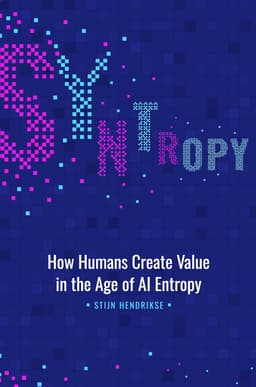
From the book
Everything on this page — signal over noise, the refinery, the Four C's, humans where it counts — is the thesis of Syntropy, Stijn Hendrikse's book on how human judgment turns AI's endless output into compounding advantage. T2D3 OS is that book, operationalized.
Model selection, context assembly, memory between sessions, hand-offs between steps, keeping every asset consistent with the foundation — that coordination is the platform's job, and it's where most AI marketing stacks quietly fail. Every frontier model is included in your subscription, so choosing one is not your problem either.
What's left is the work worth your attention: deciding who it's for, what it's for, and whether this is as good as it could be.
Bring your foundation, use every frontier model, and pull in human specialists when the work calls for it. Start free.