
Founder getting to MVP? You Are Not Confirming. You Are Discovering.
Seed-stage founders run customer research to confirm what they already believe. The real job is to find the assumptions they did not know they were making.
Stijn Hendrikse · May 24, 2026
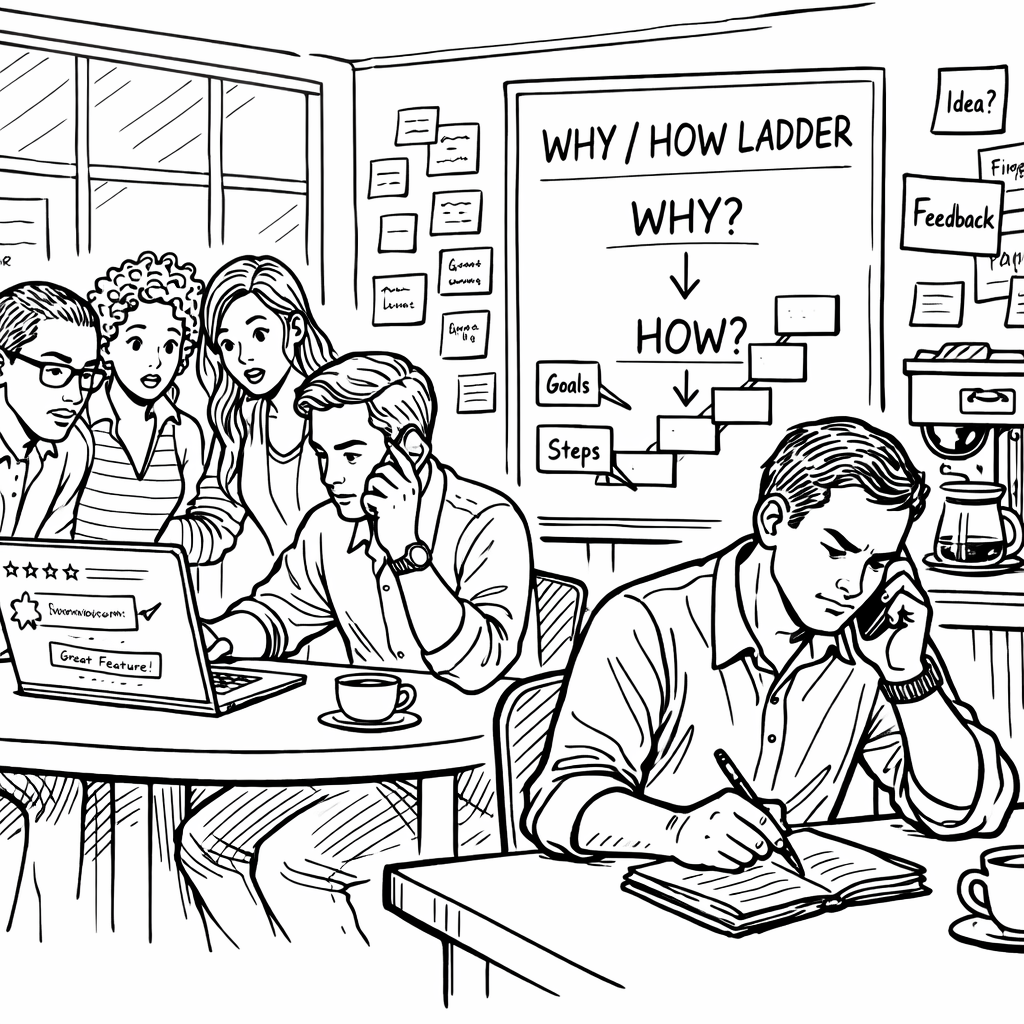
A founder I was coaching last week made an admission that every seed-stage CEO should have to make out loud at least once. His team had built a product around a thesis: their industry needed legitimacy, and their software would deliver it. Three and a half years of work, a coherent narrative, a marketing strategy organized around that one story. Then they went and talked to customers. The customers told them nobody cared about legitimacy. What they cared about was insurance processing and scheduling, two features the founder had treated as table stakes. He said, almost laughing, “We were totally caught off guard.”
That is the moment every founder needs and most founders avoid. Customer discovery is not the work of confirming what you already believe. It is the work of finding the assumptions you did not know you were making.
Seed-stage research has four moves. None of them are the move most founders run.
- Open with help, not with a pitch. Ask people to teach you about their world before you try to sell them yours.
- Climb the Why/How Ladder. Anchor in the customer’s own words, climb up with why, climb down with how, and stop before you hit platitudes.
- Sort your sources. Innovators co-build with you. Early adopters give you feedback. The early majority pays you. Different cohorts, different conversations, different scripts.
- Listen for what you were not expecting. The insurance-and-scheduling moment is the data. The legitimacy story is the noise. Most founders have it backwards.
If you run these four moves in order, the next ten conversations you have will rewrite your messaging, your roadmap, and probably your ICP. If you skip them, you will spend the next year building the product you wish people wanted instead of the product they will pay for.
The argument against this
The strongest counter-argument is that customer discovery is just market research, and market research is what you do once you have something to show. The objection runs like this: how can I ask people what they need when I have nothing to demo? The framing is wrong. You are not asking people what they need. You are asking them how they work today, what they hate about it, what they have tried, and what they would change. None of those questions require a working product. All of them require a willing interviewer.
The other counter is that early-stage interviews are biased. The friends and acquaintances you can get on the phone will tell you what you want to hear. That is partly true and entirely solvable. You ask better questions, you press past the surface, and you triangulate across enough people that the polite answers fade and the patterns emerge. The work is doable. Skipping it is not.
Open with help, not with a pitch
The most undervalued move in B2B outbound is the help request. One of the fundamental insights in human psychology is that the best way to make a friend is not to provide help. It is to ask for it. People who are unwilling to listen to a sales pitch will give half an hour of their time to someone who shows up curious and asks the right questions.
The mechanics are simple. You reach out and explain that you are trying to understand a problem in their industry. You are not selling. You are not pitching. You are not asking for a demo slot. You are asking for thirty minutes of their expertise to help you understand how the work actually gets done today. You promise nothing in return except that you will share what you learn.
That last part matters. The reciprocity has to be real. You can promise an industry report you are putting together. You can promise to send back a summary of the patterns you find across all your interviews. You can promise a small piece of useful information they did not have when they agreed to talk. The promise has to be specific, and you have to keep it.
When you run this play, three things happen that do not happen when you run a sales play. First, you get a much higher response rate, often three to five times higher than a pitch email. Second, the people who agree to talk are more candid because they think the conversation is about them, not about you. Third, the conversation produces ten times the signal because you are not steering toward a close. You are letting the other person talk. The best market research feels like an interesting conversation. The worst market research feels like a screen.
The Why/How Ladder
Most customer interviews stop too early. Someone says “the tool saves us hours” and the interviewer writes that down and moves on. The Why/How Ladder, which I wrote about at length in Syntropy, is the simplest discipline I know for forcing yourself to go deeper before moving on.
The method is straightforward. You start with a seed phrase the customer just used in their own words. You climb up by asking why. You climb down by asking how. You stop climbing up before you reach the platitude level (“save time, save money”), and you stop climbing down before you reach the tool spec level (“a CRM with a Zapier integration”). Somewhere in the middle, the real signal lives.
A worked example. A customer says, “I cannot report on the productivity of my growing team of technicians.” If you stop there, you walk away thinking you should build a reporting feature. So you climb up. Why does that matter? Because they can no longer manage the tickets in their current system. Why does that matter? Because they cannot grow the team without losing accountability. That is a strategic outcome. Now climb back down. How are they doing it today? Spreadsheets and Slack. How would your product enable it? Mobile-first ticket assignment with built-in reporting. How would they prove it worked in a pilot? Time-to-close reduction by forty percent within ninety days. Now you have a real conversation, with real stakes, that maps to real product decisions.
The reason this matters more for seed-stage founders than for any other stage is that most early-stage assumptions are at the seed-phrase level, not the climb level. You think you know what customers need because you have heard them say a sentence. You have not heard them say why the sentence matters, what they have tried before, or what failure looks like. The why/how climb is the difference between knowing what people say and knowing what people mean.
Sort your sources
A second mistake seed-stage founders make is treating every conversation as the same conversation. They are not. Geoffrey Moore broke the technology adoption curve into innovators, early adopters, early majority, late majority, and laggards. The first three matter at this stage. They are not interchangeable.
Innovators are your fellow travelers. They want you to succeed because your success validates their own bet on the future. They will help you build the product. They will give you feedback for free. They will retweet your launches. They are also, as a rule, terrible customers. They love the product because it is new, not because it solves an urgent problem. They forgive bugs. They forgive missing features. They forgive your pricing because they have not really priced the alternatives. The mistake is to take their feedback as the truth about the market. It is the truth about one part of the market.
Early adopters look like innovators but are not. They embrace your offering because it gives them an edge over their competition. They will not tell anyone else about it because the edge depends on others not knowing. They are your most valuable customers during the path to product-market fit, but they are bad references for the next cohort. You have to interview them carefully, treat them well, and not assume they will evangelize for you.
The early majority is where the revenue starts to compound. They are pragmatists. They want testimonials from people similar to themselves. They want ROI. They want to see others go first. The product they buy is not the product the innovators co-built; it is the product the early adopters quietly validated. Your job during seed stage is to use innovators and early adopters to learn what the early majority will need to see before they buy.
The implication for your research is concrete. Stop running the same interview script across all three cohorts. Innovators want to talk about the future. Ask them about it. Early adopters want to talk about their competitive advantage. Ask them about it. Early-majority prospects want to talk about risk and proof. Ask them about it. If you are running the same five questions on every call, you are missing the signal that each cohort actually offers.
Listen for what you were not expecting
The kickoff conversation I opened this piece with had a moment that should sit on every founder’s desk. The CEO had a thesis. The thesis was coherent. The thesis was wrong. The customers told him what was actually painful, and what was actually painful had nothing to do with the thesis. He told me he was “shocked.” That word should never come up in seed-stage research.
The right framing is this: every interview is a hypothesis test. The hypothesis is what you currently believe about your market. The test is whether the interview confirms or disconfirms that belief. Most founders run interviews to confirm. They ask questions whose answers can only point one direction. They steer past the disconfirming evidence. They count the “yes” responses and ignore the “well, actually” responses.
Two practices that change the math. First, you ask people what they tried before this, in detail, and you ask why those things did not work. The history of failed attempts in their workflow is far more revealing than any forward-looking question. People do not lie about what they have already tried. Second, you give them airtime. Silence works in interviews the way it works in journalism. You ask the question, and you wait. Most people will fill the gap with what matters most, which is usually the thing they had not planned to share.
If you do those two things on the next ten calls, you will hear at least one thing you did not expect. The thing you did not expect is the data. The thing you expected is the noise. Most founders have it backwards because the thing they expected is the thing they built the company around, and the thing they did not expect is the thing that contradicts the company’s narrative. Welcome the contradiction. It is the cheapest pivot you will ever buy.
Discussion items
The founders I coach who get to product-market fit faster than their peers all run customer discovery as a permanent habit, not a phase. Five practices show up across all of them.
- They book five customer conversations per week, every week, from seed stage through Series B. They do not stop when they think they have figured it out. The market keeps moving.
- They write the call notes themselves within twenty-four hours. Not a recording. Not an AI summary. Their own handwritten or typed notes, in their own words, because the act of writing forces them to wrestle with what they heard.
- They share the patterns across calls with their team weekly, with at least one disconfirming finding flagged for discussion. If every week’s report confirms the thesis, the interviews are not asking hard enough questions.
- They keep a running list of what they used to believe, when they changed their mind, and what they believe now. The list is short. The list is dated. The list is shared.
- They treat early adopters and early-majority prospects as fundamentally different cohorts and run different interview scripts for each. They never confuse innovator enthusiasm for market validation.
Questions to ask
Run these five questions through your next product or marketing standup. If your team cannot answer them quickly and concretely, you have a research gap.
- What is the most recent thing we learned from a customer conversation that contradicted what we believed two weeks ago? Can we name the customer, the moment, and the change in our thinking?
- Of the last ten customer conversations, how many were with innovators, how many with early adopters, and how many with early-majority prospects? Were we using different scripts for each?
- When a customer says a feature “saves us time,” what is the climb above that statement we have not yet asked about? What is the climb below it?
- What did our last five customers try before they tried us? Why did those alternatives fail? Are we confident in the answer?
- When was the last time a customer told us something we did not want to hear? How did we handle it? Did we change anything in response?
Sources
- T2D3, Stijn Hendrikse: https://www.t2d3.com/book
- Syntropy, Stijn Hendrikse: https://www.t2d3.com/syntropy
- Finish Line Fridays, Stijn Hendrikse: https://www.t2d3.com/finish-line-fridays
- Why/How Ladder framework: https://www.t2d3.com/blog/why-how-ladder
- Crossing the Chasm, Geoffrey Moore: https://www.amazon.com/Crossing-Chasm-3rd-Disruptive-Mainstream/dp/0062292986
- Pain-Claim-Gain framework: https://www.t2d3.com/blog/pain-claim-gain-framework