
The Great Recalibration: B2B SaaS Performance, Metrics, and the Hybrid Mandate in 2025
Reviewing the 2025 B2B SaaS landscape, from rising CAC and talent costs to the shift towards Product-Led Sales and the need for creating genuine value amidst AI-driven noise.
Stijn Hendrikse · Jan 1, 2026
The End of the "Free Lunch" Era
The B2B SaaS landscape of 2025 bears little resemblance to the exuberant, capital-flush environment of the early 2020s. We have exited the era of "growth at all costs" and entered a period of rigorous correction—a "Great Recalibration." The fundamental physics of software growth have not changed, but the economic friction has increased dramatically. The prevailing narrative for 2025 is defined by a stark dichotomy: the explosive, almost theoretical potential of AI-native efficiency versus the grinding reality of rising Customer Acquisition Costs (CAC), talent inflation, and diminishing returns on traditional go-to-market (GTM) playbooks.
For nearly a decade, the industry operated under a set of assumptions that capital was cheap, digital attention was underpriced, and software margins were infinitely scalable. By 2025, these assumptions have inverted. We are witnessing a systemic crisis in marketing economics, where the median B2B SaaS company now spends $2 to acquire just $1 of new Annual Recurring Revenue (ARR).1 This inefficiency is not merely a performance dip; it is a structural failure of the traditional siloed models of Sales-Led Growth (SLG) and Product-Led Growth (PLG).
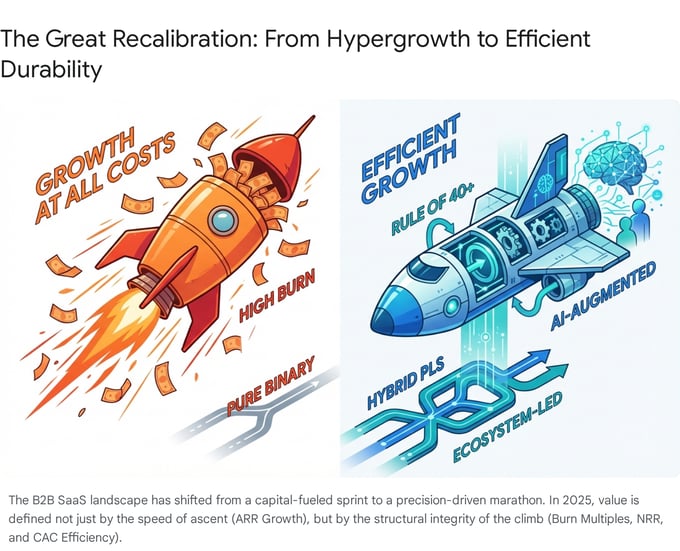
The data from 2025 benchmarks reveals a market that is unforgiving to mediocrity. While top-quartile performers continue to compound efficiently, the middle of the pack is being hollowed out. The "zombie" companies—those growing at 10-20% with poor unit economics—face an existential threat as capital markets demand a rigorous adherence to the "Rule of 40" (or in many cases, the "Rule of X").
Furthermore, the binary debate between PLG and SLG has largely dissolved into a consensus around hybridity. Pure self-service motions are struggling to move upmarket without human intervention, while pure sales-led motions are collapsing under the weight of bloated CAC and lengthened sales cycles. The winning model of 2025 is "Product-Led Sales" (PLS)—a sophisticated synthesis where product usage signals direct sales resources to high-intent opportunities.
The Syntropy Imperative in an Age of Entropy
A critical, often overlooked dimension of this 2025 landscape is the concept of "Syntropy" versus "Entropy" in information and marketing systems. As articulated in recent industry literature, we have entered the "Age of AI Entropy," where the proliferation of AI-generated content is accelerating the degradation of information quality.1 AI models, by nature, remix existing information into endless variations, each generation slightly less sharp than the last, creating an ocean of "information entropy"—irrelevant, redundant, or misleading material that drowns out genuine insights.1
The economic consequences of this entropy are staggering. Large enterprises are predicted to lose an average of $12.9 million annually due to poor data quality driven by this noise, manifesting in bad decisions and brand erosion.1 For the B2B SaaS leader, this means the traditional playbook of "buying noise" (mass content production, broad programmatic ad spend) is no longer viable. The competitive edge now belongs to "Syntropy creators"—leaders and organizations capable of creating order, coherence, and genuine signal in a complex system.1 This requires a shift from viewing marketing as a volume game to viewing it as a precision game, where human judgment is amplified, not replaced, by AI.
The T2D3 Trajectory: A Recalibrated North Star
The "T2D3" framework—Triple, Triple, Double, Double, Double—remains the aspirational trajectory for achieving unicorn status ($1B valuation) within five years.1 However, the path to achieving these milestones has fundamentally changed. In the zero-interest-rate policy (ZIRP) era, T2D3 could often be fueled by brute-force capital deployment. In 2025, T2D3 requires "efficient growth."
The journey is strictly defined by four maturity milestones:
-
MVP (Minimum Viable Product): Establishing the initial value proposition.
-
Product-Market Fit (PMF): Reaching a state where the market pulls the product, evidenced by high retention and organic referrals.
-
T2D3 Scale: The phase of exponential growth where GTM systems must scale without breaking unit economics.
-
Profitability: The ultimate destination, now prioritized much earlier in the lifecycle than before.1
This report provides an exhaustive analysis of the performance metrics, strategic shifts, and operational benchmarks defining B2B SaaS in 2025. Drawing on data from KeyBanc, OpenView, ICONIQ Growth, Bessemer Venture Partners, and proprietary frameworks like T2D3 and Syntropy, we will dissect the anatomy of efficient growth. We will explore why "renting" audiences through paid media has become a losing game, how "syntropy" offers a path out of AI-induced noise, and why new resource models like the "boat club" strategy are replacing traditional agency landscapes.1
The Financial Reality: 2025 Performance Benchmarks
The financial bedrock of the SaaS industry has shifted. Valuation multiples are no longer tethered solely to top-line growth. Instead, the market has adopted a more nuanced "efficiency-weighted" valuation framework.
The "Rule of 40" vs. The "Rule of X"
The "Rule of 40"—the principle that a company’s growth rate plus its profit margin should equal or exceed 40%—remains the north star, but its application has become more rigorous. In 2025, only 11-30% of private SaaS companies are achieving this benchmark.2 This scarcity has created a massive valuation premium; companies that reliably hit the Rule of 40 command valuations 121% higher than their peers.2
However, for top-tier companies, the bar has moved even higher. Investors are increasingly looking at the "Rule of X" (often defined as Growth + 2x Margins, or simply a higher threshold like the Rule of 50 or 60 for AI-native firms). The Bessemer Venture Partners State of the Cloud 2025 report highlights that AI-native companies, or "Supernovas," are rewriting these rules, often showing growth rates that defy traditional gravity, albeit sometimes with compressed gross margins due to high compute costs.3
When visualizing the efficiency frontier of 2025, we see a distinct clustering of companies based on their Growth vs. Profitability profile. The median SaaS company sits at approximately 21% year-over-year ARR growth with a 5% Free Cash Flow (FCF) margin. In stark contrast, the top quartile of SaaS performers achieves 50% growth with 10% margins. A unique cluster of AI-native firms appears in the high-growth/low-margin quadrant, often showing 100% growth but operating at -15% margins as they invest heavily in compute and model training to capture market share.2 This separation illustrates that the "middle" is a dangerous place to be; companies must either be highly efficient compounders or explosive growers to command a premium.
Revenue Growth: The New Normal
The era of effortless hypergrowth is over. Median private SaaS growth rates have stabilized at 19-21% following the corrections of 2022-2023.2 This is a stark contrast to the 46% median growth seen in top quartiles just a few years prior.
-
Growth Plateau: Companies are hitting a "Growth Plateau" around $20-$25 million ARR, where year-over-year growth often stagnates as they transition from early adopters to the early majority.6 This aligns with the "Chasm" theory discussed in the T2D3 playbook, where companies must shift from visionary selling to pragmatic value delivery.1
-
The AI Divergence: A bifurcated market has emerged. AI-native companies are growing at approximately 100% year-over-year—2x faster than their traditional SaaS counterparts (50% for top performers).2 This suggests that "software" is no longer a monolithic category; there is "AI-Software" and "Legacy SaaS."
-
IPO Thresholds: The bar for a public exit has doubled. To consider an IPO in 2025, a company typically needs $400-$800 million in ARR with consistent 25%+ growth.2 This extends the "private for longer" trend, forcing companies to build sustainable, cash-generative businesses rather than burning cash to the next funding round.
Net Revenue Retention (NRR): The Leaky Bucket
Retention has arguably become the most critical metric of 2025. With acquisition costs skyrocketing, the ability to expand revenue from existing customers is the primary driver of efficient growth.
-
Median NRR: The median NRR for private SaaS companies sits at roughly 101-102%, a decline from previous years.5 This indicates that upsells are barely covering churn for the average company.
-
Gross Revenue Retention (GRR): This metric remains stuck at around 86-88% for the median, below the 90% threshold considered healthy for enterprise SaaS.7
-
The AI Retention Problem: Interestingly, AI-native apps are showing retention patterns more akin to B2C consumers than B2B enterprises. High churn rates in AI tools suggest that while they are easy to adopt ("easy to buy"), they are also "easy to cancel" if they don't deeply embed into a workflow.9 Durable retention in 2025 requires deep workflow integration, not just novel generative capabilities.
CAC Payback Period: The Efficiency Gauge
The Customer Acquisition Cost (CAC) payback period has worsened, reflecting the increased difficulty in acquiring customers.
-
Median Payback: The median CAC payback period has extended to approximately 20-23 months for private SaaS companies.2 This is a deterioration from the historical benchmark of 12-14 months.
-
Segment Variation: Enterprise SaaS companies typically see payback periods of 18-24 months, while SMB-focused SaaS aims for 6-12 months.11 However, the rising cost of paid media and sales talent is pushing these numbers upward across the board.
The Marketing Efficiency Crisis: Spending $2 to Make $1
Perhaps the most alarming trend in the 2025 data is the deterioration of unit economics in customer acquisition. The premise that marketing spend reliably converts into revenue at a predictable ratio has broken down for many organizations. This phenomenon, described by Stijn Hendrikse as the "$2 to make $1" crisis, threatens the viability of the SaaS model itself.1
The $2 Dollar Problem
The median B2B SaaS company now spends $2 to acquire $1 of new ARR.1 In the most severe cases, companies are burning nearly $3 for every dollar of new revenue. This indicates an LTV:CAC ratio that has arguably dropped below 1:1 for the least efficient cohorts—meaning they are paying more to acquire customers than those customers will ever return in gross profit.1
Several structural factors drive this inflation:
-
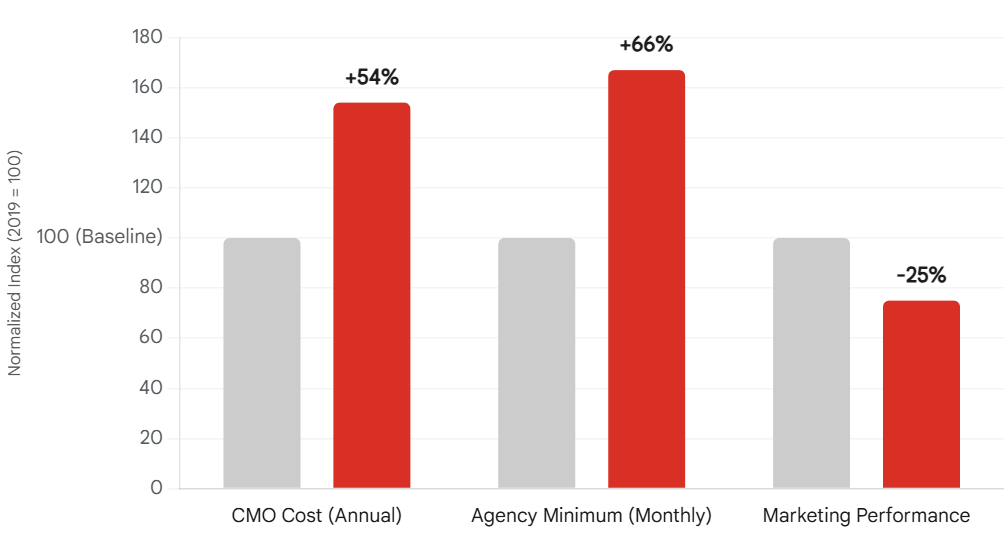
Talent Cost Explosion: The cost of marketing talent has outpaced general inflation significantly. The fully loaded cost of a CMO has risen 54% from 2019 to 2025, reaching nearly $400,000. Even mid-level roles like Marketing Managers have seen 40% salary increases, rising from $120,000 to $165,000.1
-
Vanishing Talent Arbitrage: Remote work has equalized compensation. A startup in a low-cost region can no longer pay local rates; they compete globally with Silicon Valley packages.1
-
Complexity Overhead: A marketing strategy in 2019 might have involved five core channels. In 2025, it involves 15+ touchpoints (ABM, multiple social platforms, community, influencers, partner channels, etc.). Managing this complexity creates a "coordination tax" that consumes up to 20% of leadership time.1
The Marketing Inflation Gap: Costs vs. Performance (2019-2025)
The Failure of "Rented" Audiences
The cost of "renting" attention—through paid media, sponsorships, and gatekeepers—has become prohibitive. Agency minimums have nearly doubled, with standard monthly retainers rising from $3,000 in 2019 to $5,000+ in 2025.1 Specialized skills like SEO command freelancer rates of $150 per hour, double the rate of 2019.
This rising cost has forced a strategic pivot from "rented" to "owned" audiences.
-
Entropy (Noise): The default state of the internet in 2025 is noise, accelerated by AI-generated content. AI remixes existing information, leading to "information entropy" where clarity dissolves. Brands that simply churn out volume via "content mills" are generating entropy.1
-
Syntropy (Signal): The antidote is creating "syntropy"—order and clarity. Value accrues to those who can create genuine signal: proprietary data, deep human insight, and trusted relationships. This requires a shift from "renting" audiences (paid ads) to "owning" them (communities, newsletters, first-party data).1
Furthermore, B2B buyers have built a "trust deficit" with vendors. Data shows that 82% of buyers trust coworkers and internal management over vendor claims, and 71% trust third-party opinions.13 This makes paid media less effective as a standalone channel; it must be supported by "owned" trust assets like thought leadership and community engagement.
The "No Free Lunch" Reality in AI
While AI was promised as a deflationary force that would lower costs, it has paradoxically increased them in the short term. This is the "AI Paradox." AI-skilled marketers command a 43% wage premium.1 Furthermore, the "noise proliferation" caused by AI means that breaking through requires higher quality, more distinctive (and thus more expensive) content, not cheaper volume. The "free lunch" of automated content generation has proven to be an illusion; it produces commodity content that fails to convert in a trust-deficit market.1 Companies relying on AI to simply produce more are finding that their CAC is increasing, not decreasing, because they are competing in a saturated attention economy.
The Model Wars: PLG vs. SLG vs. Hybrid
The binary distinction between Product-Led Growth (PLG) and Sales-Led Growth (SLG) has effectively collapsed. In 2025, the dominant and most successful model is Product-Led Sales (PLS) or the Hybrid Model. The data suggests that pure-play models on either extreme are struggling to scale efficiently.
Comparative Metrics: PLG vs. SLG
Despite the convergence, distinct metric profiles remain for companies leaning heavily in one direction. Understanding these baselines is crucial for benchmarking performance.
| Metric | Product-Led Growth (PLG) | Sales-Led Growth (SLG) | Analysis |
|---|---|---|---|
| CAC Payback | < 12 Months (Ideal) Median ~18-20 months | 18-24 Months Median ~20-23 months | PLG traditionally recovers costs faster due to lower sales headcount. However, as PLG companies scale and add sales teams, this gap is narrowing.14 The "efficiency" of PLG is often eroded by high R&D spend required to maintain a consumer-grade experience. |
| Customer Acquisition Cost (CAC) | Lower | Higher | PLG lowers CAC by removing human touchpoints from the initial transaction. SLG bears the heavy load of SDRs, AEs, and long sales cycles. However, PLG companies often see higher marketing CAC as they rely heavily on inbound demand generation.16 |
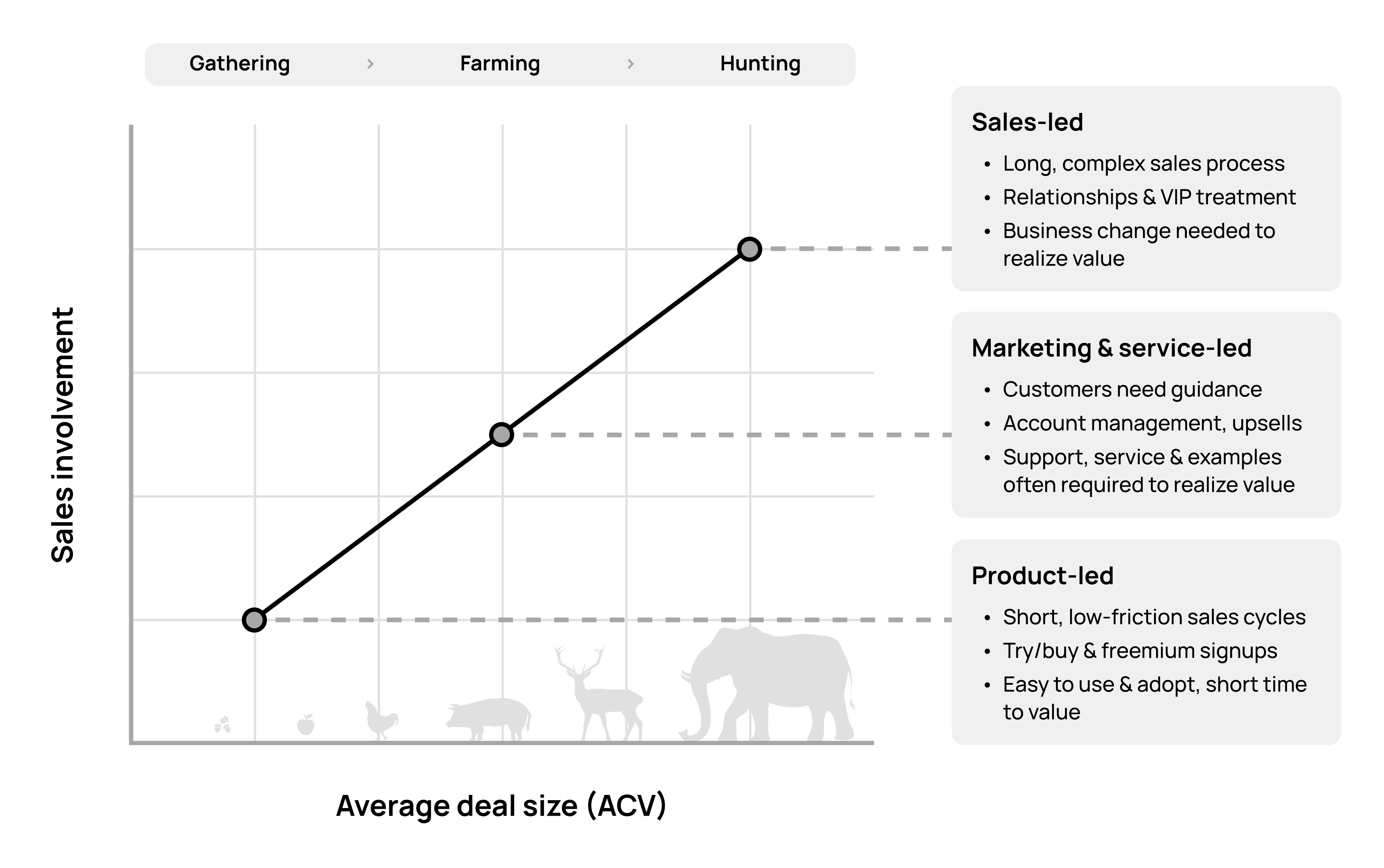
| Annual Contract Value (ACV) | Lower ($1k - $10k) | Higher ($50k - $100k+) | SLG is essential for capturing enterprise value. PLG struggles to close 6-figure deals without human intervention.16 The T2D3 playbook notes that you cannot "catch elephants with a bow and arrow" (SLG tactics for enterprise) but you also can't "catch rabbits with an elephant gun" (SLG costs for SMBs).1 |
| Conversion Rate | Visitor-to-Signup: ~5-12% Free-to-Paid: ~5-9% | Lead-to-Close: ~1-5% (Variable) | PLG relies on volume. A 9% free-to-paid conversion is considered a strong benchmark.17 Product Qualified Leads (PQLs) are the gold standard, converting at 30-39%, far outperforming traditional MQLs.17 |
| Net Revenue Retention (NRR) | Variable (High churn in SMB/Prosumer) | Higher (110%+) | SLG models often lock in multi-year contracts, stabilizing retention. PLG faces "consumer-like" churn risks, especially in AI-native apps where switching costs are low.9 |
The Rise of Product-Led Sales (Hybrid)
The most successful companies in 2025 use a "Hybrid" motion. They use PLG mechanics (free trials, freemium) to fill the top of the funnel cheaply and then layer on a sales team to close enterprise accounts and drive expansion.
-
The "PLG Squeeze": Pure PLG companies are hitting a ceiling. To reach $100M ARR (Centaur status), they must layer in enterprise sales.18 Relying solely on self-serve often stalls growth at the $10M-$20M ARR mark as the company exhausts the "early adopter" market segment.
-
The "SLG Efficiency": Traditional SLG companies are adopting PLG tactics (interactive demos, self-serve onboarding) to reduce CAC and shorten sales cycles.19 By allowing customers to educate themselves, sales reps can focus only on high-intent, high-value conversations.
-
Metrics: Companies making the transition to hybrid/self-serve report 2x higher profitability and significantly better efficiency metrics. Specifically, companies with established self-serve motions often exceed $300k revenue per employee, compared to <$100k for those without.20
T2D3 in the Modern Era
The T2D3 benchmark (Triple, Triple, Double, Double, Double) remains the "gold standard" for VC-backed unicorn trajectories, but achieving it in 2025 requires a precise sequence of execution. The T2D3 playbook emphasizes that you cannot simply "hope" for viral PLG. It requires a structured journey from MVP to Product-Market Fit (PMF) to Scale.
-
Nailing a Niche: You cannot be both a "daisy and an orchid." Growth requires staking a claim to a specific audience ("Nailing a Niche") to avoid commoditization.1 In a crowded AI market, specificity is the only defense against entropy.
-
ABM as the Equalizer: For companies that cannot rely on viral PLG loops, Account-Based Marketing (ABM) serves as the necessary outbound complement, "flipping the funnel" to target high-value accounts directly.1 This is particularly critical for the "Elephant" hunting segment ($100k+ ACV).
Emerging Growth Vectors: Ecosystems and Marketplaces
As direct acquisition channels become saturated and expensive, B2B SaaS companies are migrating toward ecosystem-led growth. The "Channel" is no longer just a strategy for hardware or legacy software; it is a primary lever for SaaS efficiency in 2025.
The Cloud Marketplace Revolution
Cloud Marketplaces (AWS, Azure, Google Cloud) have transformed from niche fulfillment channels to dominant revenue drivers.
-
Transaction Volume: It is projected that nearly one-third (32%) of SaaS revenue will transact via marketplaces in 2025, a 60% increase from previous years.21
-
Budget Access: Marketplaces allow buyers to burn down committed cloud spend (EDP/MACC commitments), which speeds up deal cycles and reduces friction. 75% of companies report access to committed spend as a major advantage.21 This essentially unlocks budgets that are already approved but unspent.
-
Net New Revenue: Contrary to the belief that marketplaces only process existing deals, 62% of companies are generating net-new revenue through these channels.22 This makes Marketplaces a true GTM channel, not just a billing mechanism.
Partner-Led Growth: The Economics of Trust
The channel provides a path to lower CAC and higher efficiency.
-
Revenue Contribution: High-performing partner programs now source 25%+ of total revenue.23
-
Efficiency: Deals involving partners close 25% faster and have lower CAC than direct deals.24 Partners bring trust to the table, bypassing the skepticism that slows down direct sales.
-
The "Ecosystem Economy": By 2026, it is projected that 60% of global revenue will come from partner-driven models.25
-
Hidden Costs: However, channel sales are not "free." Companies must account for commissions (typically 15-40%), deal acceleration expenses, and the risk of price erosion.26 Companies heavily reliant on channels may price their products 15-25% higher to preserve margins.26
The Human Element: Teams and Talent in the AI Era
The rapid integration of AI is not replacing marketers; it is redefining the baseline for competence and value creation. The fear of replacement is giving way to a reality of "augmentation or obsolescence."
Syntropy: The New Skillset
As AI lowers the cost of content production to zero, the value of generating content collapses. The value shifts entirely to Syntropy—the human ability to create order, meaning, and "signal" from the noise.
-
Role Evolution: The "Syntropy" framework predicts specific shifts for creative roles:
-
Copywriters => Storytellers (Crafting narrative arcs that AI cannot hallucinate).
-
Designers ==> Sculptors (Curating and refining AI outputs).
-
Strategists ==> Navigators (Setting direction amidst infinite options).1
-
-
The "Linchpin" Risk: AI has already automated "cog" work (tasks with clear instructions). It is now encroaching on "linchpin" work (creative initiative). Professionals must move further up the value chain to "Chief Signal Creator" roles, using AI to amplify their judgment rather than just their output.1
The "Boat Club" Model vs. The Agency Maze
Companies are rethinking how they resource marketing. The traditional "Agency Maze"—hiring separate agencies for SEO, PPC, Content, and Ops—creates fragmentation and lacks accountability. The "hidden costs" of this model include massive coordination overhead (up to 20% of leadership time) and redundancy penalties (paying multiple vendors for the same work).1
-
The Alternative: The "Boat Club" strategy (exemplified by models like Kalungi) suggests a shared-resource model. Instead of "buying a boat" (hiring a full expensive team) or "renting from random marinas" (disjointed agencies), companies join a "club" where they get access to a full stack of senior talent (CMO, Strategist, Specialists) for a fraction of the cost, often with pay-for-performance incentives.1
-
Accountability Vacuum: Traditional agencies charge for inputs (hours/deliverables). The new model demands charging for outcomes (leads/revenue), aligning incentives with the "Spending $2 to Make $1" reality. This shift forces vendors to have "skin in the game," ensuring that marketing spend is directly tied to ARR growth.1
Agentic AI: The New Workforce
Beyond human talent, "Agentic AI" is emerging as a new layer of the workforce. Unlike passive tools that wait for prompts, AI agents can actively monitor pipelines, route leads, and even conduct autonomous outreach.
-
Impact: By 2026, AI agents are expected to handle core workflows in ABM and content strategy.27 This shifts the human role from "doer" to "auditor" and "strategist."
-
The Trust Barrier: However, as AI takes over more interactions, the "trust deficit" widens. Buyers crave human connection. The most successful sales models will be those that use AI for backend efficiency (research, routing, scoring) while reserving human talent for high-impact, empathetic interactions.28
Strategic Recommendations for 2025
The data paints a clear picture: The "middle" is dead. You must either be a hyper-efficient, product-led compounder or a high-ACV, enterprise-grade machine. To survive and thrive in 2025, B2B SaaS leaders must adopt a new set of strategic imperatives.
-
Stop Renting, Start Owning: Move budget from paid media arbitrage (which is getting more expensive) to building owned audiences (communities, email lists, proprietary data). Leverage content syndication as a bridge to ownership.29
-
Hybridize Your Motion: If you are PLG, build an enterprise sales motion immediately to capture value. If you are SLG, build a "product tour" or "light" version to reduce CAC and warm up leads.
-
Audit for Syntropy: Ruthlessly audit your content and marketing. If it looks like it could have been written by an LLM, it is "entropy" (noise). Cut it. Invest only in "signal"—deep customer stories, original research, and contrarian points of view.1
-
Leverage Ecosystems: Do not go it alone. List on Cloud Marketplaces to reduce friction and access committed spend. Build partner channels to lower CAC and increase deal velocity.21
-
Measure Efficiency, Not Just Growth: Replace "Growth at all costs" with "Efficient Growth." Monitor your Rule of 40, CAC Payback, and Revenue per Employee like a hawk. Use the scorecard below to assess your health.
Conclusion: The Survival of the Fittest
2025 is not a year for the faint of heart. The rising tides of capital are gone; now, you must swim. The winners will not be those who spend the most, but those who orchestrate the most efficient systems—integrating AI without losing humanity, blending sales and product without friction, and prioritizing profit alongside growth. The "free lunch" is over, but for those who adapt, the feast is just beginning.